
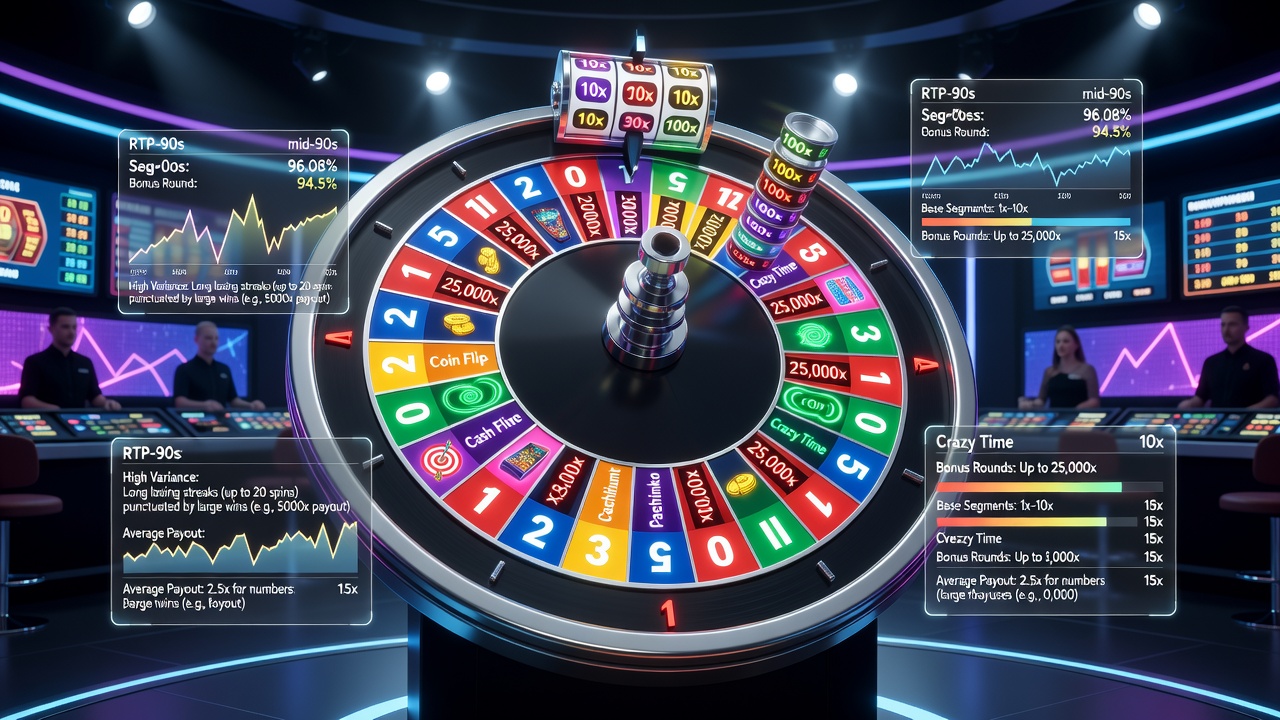
A single wheel spin on Crazy Time can pay out 25,000 times your stake. That number alone explains why the game has become one of the most discussed live casino products in recent years, but it also obscures a more useful truth: the headline multiplier tells you almost nothing about what you can expect to win over the long run. The number that actually matters - the one that separates informed players from those chasing a mirage - is crazy time RTP.
Return to player figures rarely get the attention they deserve, buried in terms pages or glossed over in favor of flashy bonus round footage. Yet understanding crazy time RTP percentage changes how you approach the game entirely. It reframes each bet segment, each bonus round, each side bet as part of a mathematical system rather than a lottery ticket. For readers who want a clear breakdown of how the mechanic works, this page on crazy time rtp percentage offers a useful reference point before you dig into the details below.
What follows is a full explanation of how RTP is calculated, why it shifts depending on which bet you place, how volatility interacts with return figures, and what all of this means for realistic payout expectations. No guesswork, no inflated promises - just the mechanics behind the numbers.
What Is Crazy Time RTP and Why It Matters
Defining Return to Player in Live Casino Games
Return to player is a theoretical percentage that represents how much of all wagered money a game returns to players over an extended number of rounds. It is not a guarantee for any single session - it is a statistical average calculated across millions of spins. A crazy time RTP return to player figure in the mid-90s percent range means that, over a very long timeline, the game is designed to return that proportion of total stakes, with the remainder representing the house edge.
How RTP Differs From Payout Percentage
People often use "RTP" and "payout percentage" interchangeably, but there is a subtle distinction worth understanding. Crazy time payout percentage typically refers to the same underlying concept - the ratio of returns to wagers - but the term is sometimes used to describe short-term payout behavior rather than the long-term theoretical average. RTP is the design specification; payout percentage can describe what actually happened during a specific stretch of play, which may drift meaningfully from the theoretical number due to variance.
Why RTP Is Not a Promise of Winnings
No RTP figure guarantees anything for an individual player in a single session. A game with a 96% RTP can still produce a losing night for one player and a triple-your-money night for another. The percentage only becomes meaningful at scale, which is why treating it as a session-by-session predictor leads to frustration rather than insight.
Breaking Down the Crazy Time RTP Percentage
Base Bet Segments and Their Individual RTP
Crazy Time is not a single-RTP game. Each betting option - the numbers, the four bonus segments - carries its own distinct return rate. The number segments (1, 2, 5, and 10) tend to have different theoretical returns from one another, and the bonus rounds each carry their own calculated RTP based on how frequently they land and how their multiplier mechanics behave.
Bonus Round RTP Variations
The four bonus segments - Coin Flip, Cash Hunt, Pachinko, and Crazy Time - each have appearance frequencies built into the wheel design. Because they land less often than the number segments but can produce dramatically higher multipliers, their contribution to overall RTP works differently. A bonus round with a lower hit frequency but a higher average multiplier can still contribute a comparable, or even superior, RTP figure to a base number bet.
Top Slot Multiplier Impact on Overall Return
Before each spin, a top slot mechanic applies multipliers to random segments, occasionally stacking extreme values onto bonus rounds. This mechanic is factored directly into the published RTP figures. It introduces additional variance without technically shifting the long-term theoretical return outside its designed range, since the multiplier distribution itself is mathematically fixed.
- Number segments generally offer more frequent, smaller wins
- Bonus rounds offer rarer, potentially much larger wins
- Top slot multipliers add unpredictability without altering the underlying math
Crazy Time Game Volatility Explained
What Volatility Means in Practical Terms
Volatility describes how much and how often a game's results swing away from the average. High volatility means longer losing stretches punctuated by occasional large wins; low volatility means smaller, more frequent, more predictable returns. Crazy time game volatility sits on the higher end of the spectrum, driven almost entirely by its bonus round structure and multiplier potential.
How Bonus Rounds Drive Volatility Higher
Because the biggest multipliers are locked behind infrequent bonus segments, results can remain flat for extended periods before a single round delivers an outsized return. This is the defining characteristic of the game's volatility profile - it rewards patience and bankroll discipline far more than it rewards short bursts of aggressive betting.
Volatility's Relationship With RTP
RTP and volatility measure two different things, and conflating them leads to poor decision-making. RTP tells you what to expect on average; volatility tells you how bumpy the road will be getting there. A game can have a perfectly respectable RTP while still delivering a rough, unpredictable short-term experience - which is exactly the situation with Crazy Time.
How Crazy Time Payout Percentage Affects Real Play
Short-Term Results vs Long-Term Averages
Over a session of fifty or a hundred spins, actual payout behavior can diverge sharply from the theoretical RTP. This isn't a flaw in the math - it's the expected consequence of variance operating over a small sample. Only across tens of thousands of rounds does the observed payout percentage begin to converge with the published theoretical figure.
Bet Distribution and Its Effect on Personal Payout Experience
How you split your wager across segments directly shapes your personal payout experience, even though it doesn't change the game's underlying RTP. Concentrating stakes entirely on bonus segments produces a different variance profile than spreading bets across numbers and bonuses combined, even if both approaches theoretically converge toward similar long-run returns.
Bankroll Management Given High Payout Variance
Given the payout swings inherent to this game, disciplined bankroll sizing matters more here than in lower-volatility formats. Setting a fixed loss limit per session and resisting the urge to chase a missed bonus round are practical habits that align betting behavior with the game's actual statistical nature rather than its emotional pull.
Comparing Crazy Time RTP to Other Live Casino Games
Crazy Time vs Traditional Wheel Games
Compared to simpler wheel-based formats without bonus rounds, Crazy Time's layered structure produces a more complex RTP profile. Traditional single-wheel games often carry more uniform return rates across segments, while Crazy Time's segmented RTP structure means your effective return depends heavily on where you place your money.
Crazy Time vs Other Multiplier-Based Live Games
Other multiplier-driven live titles share a similar philosophy - reward rare bonus outcomes with disproportionate returns - but differ in hit frequency and multiplier ceilings. Crazy Time's specific combination of four distinct bonus mechanics gives it a broader payout distribution than most comparable titles, which contributes to its reputation for both spectacular wins and prolonged dry spells.
What the Comparison Reveals About Player Expectations
Viewed side by side with other formats, Crazy Time's RTP profile confirms that it's built for players who value occasional dramatic outcomes over steady, incremental returns. Recognizing this before playing helps set realistic expectations rather than measuring the game against lower-volatility alternatives.
Practical Tips for Playing With RTP and Volatility in Mind
Choosing Bets Based on Personal Risk Tolerance
Players who prefer steadier, smaller returns tend to favor number segments, while those comfortable with longer losing streaks in exchange for occasional large multipliers gravitate toward bonus-heavy strategies. Neither approach is objectively superior - they simply align with different risk appetites.
Reading Session Results in Context
A losing session doesn't indicate a broken game, and a windfall session doesn't indicate a beatable one. Judging the game's fairness from a handful of rounds misunderstands how RTP functions mathematically. Meaningful conclusions require volume, not a single evening's outcome.
Setting Realistic Expectations for Long-Term Play
Treat the published RTP as a long-run compass rather than a short-term forecast. Combine that understanding with firm bankroll limits, and the game becomes far more enjoyable as entertainment rather than a source of financial frustration.
Frequently Asked Questions
Does Crazy Time have one single RTP figure for the whole game?
No. Each betting option - the numbers and each bonus round - has its own individual RTP. The overall figure often quoted publicly is a blended average, but your actual return depends on which segments you choose to bet on.
Is a higher RTP always better for players?
A higher RTP generally favors players over time, but it doesn't account for volatility. A high-RTP option with high volatility can still produce long losing streaks before evening out, so RTP alone shouldn't guide every betting decision.
Why did my payout percentage differ so much from the published RTP?
Short sessions are subject to significant variance. The published RTP reflects millions of simulated or recorded rounds, while any individual session - even a long one - represents a tiny fraction of that sample size and can deviate substantially.
Which bet type offers the most stable returns?
Number segments, particularly the ones that appear most frequently on the wheel, tend to produce steadier, smaller payouts compared to bonus rounds. They suit players who prioritize consistency over occasional large multipliers.
Does the top slot multiplier change the game's RTP over time?
The top slot mechanic is already factored into the published RTP figures. It increases short-term unpredictability by occasionally boosting specific segments, but it doesn't push the long-term theoretical return outside its designed range.
How does volatility affect bankroll planning?
Higher volatility means you should budget for longer losing stretches without assuming something is wrong. Allocating a fixed session bankroll and avoiding bet increases after losses helps align your play with the game's actual statistical behavior.