
A coin balanced on its edge after a flip lands there roughly once in every six thousand tosses on a hard surface - a statistic that surprises people who assume a coin only ever gives two answers. That single fact hints at something larger: the humble coin flip, treated as the purest symbol of fifty-fifty chance, hides a surprising amount of physics, psychology, and mathematical mischief. Once you start looking closely, the "simple" coin toss stops being simple at all.
Flip enthusiasts, game designers, and math hobbyists have spent decades inventing unusual coin toss rules that twist this basic action into something far more interesting than calling heads or tails. Some of these variations reward patience, others punish greed, and a few exist purely to expose how badly humans misjudge randomness. If you want to see how far a coin-based mechanic can be pushed for entertainment, a well-built random coin flip game like the one available here shows how digital design can amplify the tension of a single toss into a full session of strategic decisions.
This piece walks through the strangest rule sets, the most demanding flipping challenges, the reasons outcomes feel unpredictable even when the physics is well understood, and the probability puzzles that keep mathematicians revisiting a topic most people think they mastered in grade school.
Why the Coin Toss Still Fascinates Mathematicians and Game Designers
The coin toss survives as a cultural shorthand for fairness because it appears to strip away skill, bias, and negotiation. Two outcomes, equal weight, no argument. That appearance of simplicity is exactly why it keeps attracting serious analytical attention - the gap between perceived randomness and actual physical behavior is wide enough to build entire research careers on.
The Illusion of Fifty-Fifty
A tossed coin is not a random number generator; it is a mechanical system governed by initial force, spin rate, and air resistance. Researchers who have modeled coin flips mechanically found that a coin tends to land on the same face it started on slightly more often than not, because the flipping motion introduces a small but measurable bias. The margin is thin, but it is real, and it undermines the assumption that every toss resets to a clean fifty-fifty split.
From Ancient Divination to Modern Game Design
Coin-based decision making predates modern probability theory by centuries. Ancient cultures used coin-like objects to settle disputes or seek guidance, trusting the outcome precisely because no human hand could be blamed for it. Modern game designers inherited that trust and built on it, layering unusual coin toss rules on top of the basic mechanic to create tension, strategy, and replay value that a plain heads-or-tails call could never offer.
Why Designers Keep Reinventing the Toss
A single flip resolves in under two seconds and offers no meaningful decision point. Designers who want engagement need friction - multiple flips, conditional rules, escalating stakes. That need is what drives the constant invention of coin flipping challenges across tabletop games, mobile apps, and classroom probability lessons alike.
Unusual Coin Toss Rules That Change the Entire Game
Standard coin tosses ask one question: heads or tails. Unusual coin toss rules ask several questions at once, forcing players to weigh risk against reward instead of simply hoping for the right side.
Best-of-Three and Sudden-Death Variants
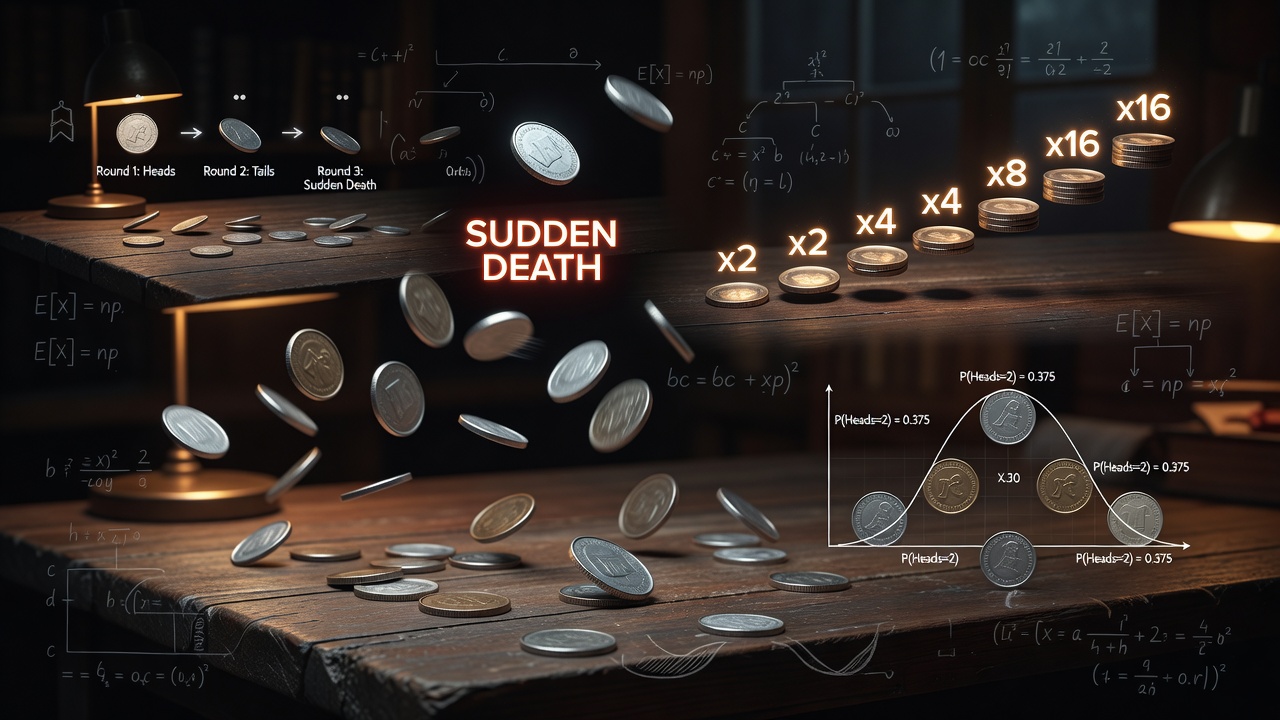
Instead of settling a decision on one flip, best-of-three formats demand consistency across multiple tosses, which changes the statistical picture significantly. A single flip has two outcomes; three flips create eight possible sequences, and only some of those sequences produce a clean majority. Sudden-death variants go further, restarting the count the moment a tie occurs, which can stretch a supposedly quick decision into a surprisingly long exchange.
Streak-Based and Escalating Stake Rules
Some rule sets reward or punish streaks directly. A common variant doubles the stakes every time the same face appears consecutively, testing whether players understand that previous flips have no influence on the next one. This is where coin flip probability puzzles quietly sneak into casual play - players who believe a streak makes the opposite outcome "due" are falling for the gambler's fallacy, a well-documented misunderstanding of independent events.
Multi-Coin and Team-Based Tosses
Flipping several coins simultaneously and scoring based on the total number of heads introduces a binomial distribution instead of a simple binary result. With four coins, for example, getting exactly two heads is more likely than getting four heads or zero heads, even though each individual coin still has even odds. Team-based variants split flipping duties among players, adding a social layer where trust and turn order matter as much as the coin itself.
- Best-of-three and best-of-five formats for tie-breaking decisions
- Escalating-stakes rules tied to consecutive identical outcomes
- Multi-coin scoring based on total heads or tails count
- Reverse-call rules where the loser of the call gets to choose the physical coin
Random Coin Flip Games Across Cultures and Digital Platforms
The coin flip has moved far beyond dispute resolution. It now anchors entire genres of games, both physical and digital, precisely because its outcome feels untouchable by human interference.
Traditional Physical Games Built Around the Toss
Street games in many regions use coin tosses as an entry mechanic, deciding turn order or stake size before a larger game begins. These traditions persist because the toss requires no equipment beyond a coin and no explanation beyond a shared cultural understanding of what heads and tails mean.
Digital Adaptations and Algorithmic Fairness
A random coin flip game built for a screen has to solve a problem physical coins never face: proving fairness without a visible object to inspect. Developers rely on cryptographically sound random number generators to simulate the toss, and reputable platforms publish or audit their randomness sources so players can trust the digital equivalent of a fair coin. The best-designed versions replicate the psychological tension of a real toss - the pause, the reveal, the immediate emotional reaction - while guaranteeing statistical fairness behind the scenes.
Hybrid Formats Blending Chance and Choice
Some modern games use the coin flip as a gateway event rather than the entire experience, triggering a bonus round or multiplier only after a successful call. This hybrid approach keeps the core unpredictability of a toss while giving players a sense of agency once the flip resolves, a structure that has proven popular in casual mobile game design.
Coin Flipping Challenges That Test Skill, Patience, and Nerve
Not every coin-based activity relies purely on chance. A surprising number of challenges test physical skill or mental discipline layered on top of the random result.
Trick Flips and Precision Catching
Competitive coin flippers practice controlled spins, aiming for a consistent number of rotations before catching the coin cleanly on the back of one hand. This skill-based layer does not change the coin's final outcome, but it adds a performance dimension that turns a mundane action into a display of dexterity.
Blind Calling and Delayed Reveal Formats
In blind calling challenges, players must commit to heads or tails before the coin even leaves the flipper's hand, removing any chance of reading the coin's spin or the flipper's body language. Delayed reveal formats add psychological pressure by covering the coin after it lands, forcing a wait before the result is known - a small but effective way to heighten anticipation.
Endurance Formats: Longest Streak Wins
Endurance-style coin flipping challenges ask participants to keep flipping until a specific pattern breaks, tracking who can produce the longest streak of matching outcomes. These formats double as an informal statistics lesson, since most participants underestimate how long streaks can naturally occur even in a fair, unbiased sequence.
Why Coin Toss Outcomes Feel So Unpredictable
People consistently misjudge randomness, and the coin toss is one of the clearest examples of this gap between intuition and reality.
The Gambler's Fallacy in Action
After five consecutive heads, most people expect tails to be "overdue." It is not. Each flip is statistically independent, meaning the coin has no memory of previous results. This misunderstanding fuels much of the drama around unpredictable coin toss outcomes, since observers assign meaning to sequences that are, mathematically, no more remarkable than any other.
Pattern Recognition and False Meaning
Human brains are wired to detect patterns, even in data that contains none. A run of three heads in a row feels significant; a scattered HTHTHT sequence feels "more random," even though both are equally likely in a genuinely fair sequence of six flips. This bias explains why spectators often gasp at streaks that are, statistically speaking, unremarkable.
Physical Variables That Introduce Real Bias
Beyond psychology, real physical factors shape outcomes. The starting position of the coin, the force of the flip, the surface it lands on, and even air currents can nudge results slightly away from a perfect fifty-fifty split. These micro-biases are too small to exploit reliably by eye, but they are large enough that physicists studying coin mechanics have documented them consistently.
Coin Flip Probability Puzzles That Challenge Common Sense
Beyond casual play, the coin toss serves as a foundation for some of the most counterintuitive puzzles in introductory probability theory.
The Waiting Time Paradox
Ask how many flips it takes, on average, to see two heads in a row versus a head followed by a tail, and most people guess the same number for both. The actual expected wait differs significantly - a head-then-tail sequence appears faster on average than two heads in a row, a result that surprises even people comfortable with basic probability.
The Birthday-Style Coincidence Problem
Flip enough coins in a group setting, and the odds that at least two people produce an identical sequence of results climb far faster than intuition suggests. This mirrors the logic behind the well-known birthday paradox, where shared outcomes become likely much sooner than expected once enough participants are involved.
Conditional Probability Traps
A classic puzzle asks: if you flip two coins and are told at least one is heads, what is the probability both are heads? Most people answer one-half; the correct answer is one-third, because the condition eliminates the tails-tails outcome but leaves three equally likely remaining combinations. Puzzles like this reveal how easily conditional information gets misapplied, even by people confident in their grasp of basic odds.
Simulated Trials and the Law of Large Numbers
Flip a coin ten times and an uneven split feels almost guaranteed; flip it ten thousand times and the ratio creeps steadily toward fifty-fifty. This convergence, known as the law of large numbers, explains why short unusual coin toss rules sessions can feel wildly unfair even when the underlying mechanic is perfectly balanced.
Frequently Asked Questions
Is a real coin toss actually a fifty-fifty chance?
Very close to it, but not exactly. Mechanical studies of coin flipping show a slight bias toward the starting face landing up again, caused by the physics of the spin rather than any flaw in the coin itself. The bias is small enough that it rarely matters outside controlled experiments.
Can a coin be weighted to guarantee a specific outcome?
Yes, physically altering a coin's weight distribution can shift the odds meaningfully, which is why fair-play rules in serious contexts require a neutral third party to inspect or provide the coin. Standard, unaltered coins used in normal conditions do not show this kind of deliberate bias.
Why do digital coin flip games feel different from real coin tosses?
Digital versions rely on random number generators instead of physics, removing the small mechanical biases present in real flips while introducing new questions about algorithmic transparency. Trustworthy platforms address this by using verified randomness sources so results remain statistically fair even without a physical object to inspect.
What is the gambler's fallacy and how does it relate to coin tosses?
It is the mistaken belief that past independent results influence future ones, such as assuming tails is "due" after several heads in a row. Each coin flip remains statistically independent regardless of prior outcomes, so no streak changes the odds of the next flip.
Are multi-coin flipping games harder to predict than single-coin tosses?
They follow different math rather than being simply harder to predict. Multiple coins flipped together produce a binomial distribution, meaning middle outcomes like an even split of heads and tails become more common than extreme outcomes like all heads or all tails.
How long should a coin flipping challenge run to produce a fair result?
Short sessions of just a few flips can easily produce lopsided results purely by chance, even with a perfectly fair coin. Longer sessions, following the law of large numbers, tend to average out toward an even split, making them more reliable for settling genuinely close decisions.